




Estimated reading time: 6 minutes
YUGEN REALTY, SURAT
Surat is rapidly emerging as one of India’s fastest-growing commercial and financial centers. With the expansion of industries, trade, startups, real estate, and financial services, the city’s economy continues to strengthen. At such a time, urban policies and taxation systems must also be progressive, rational, and fair.
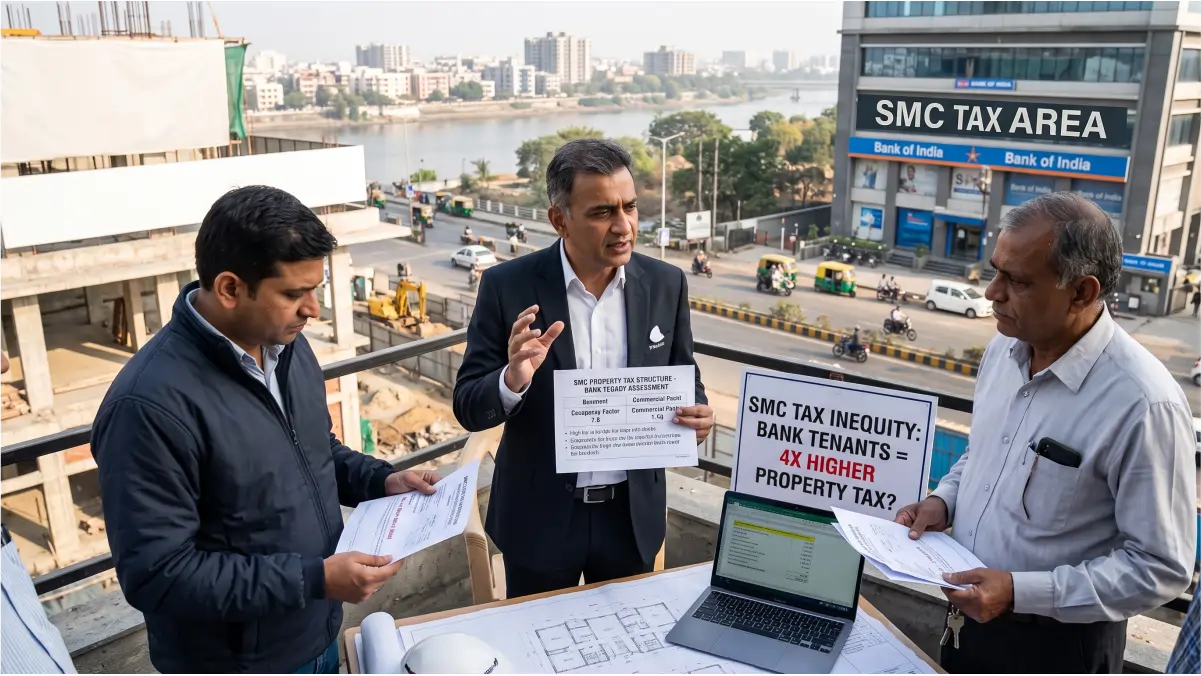
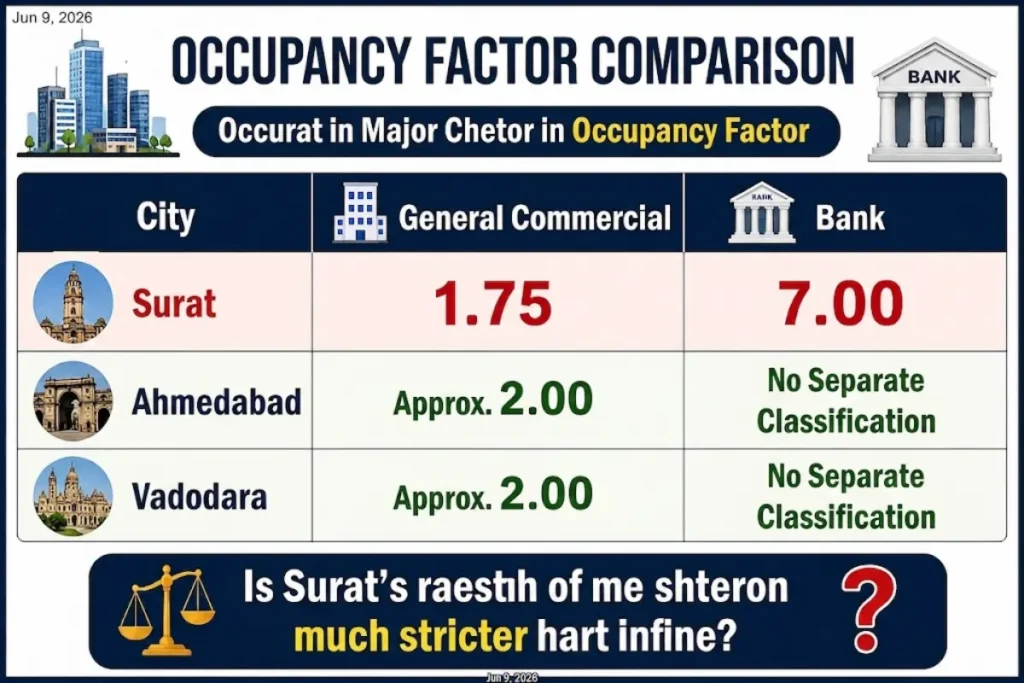
Recently, a provision in the Surat Municipal Corporation’s (SMC) property tax structure relating to bank tenants has become a subject of discussion. Under the current system, a standard commercial property carries an occupancy factor of 1.75. However, if the same property is leased to a bank, the occupancy factor increases to 7.00.
In simple terms, the same property, in the same location, with the same physical characteristics, can become liable for nearly four times the property tax merely because of the type of tenant occupying it.

This raises a fundamental question :
Does a property truly become four times more taxable simply because it is occupied by a bank?
A Fundamental Question of Fairness
The primary purpose of property tax is to help municipalities recover the cost of providing civic infrastructure and public services. Roads, street lighting, drainage systems, waste management, and other urban services are typically funded through property taxation, which is generally linked to a property’s size, usage, and location.
However, does a bank branch consume four times more water than another commercial office? Does it require four times more road infrastructure? Does it utilize four times more municipal services?
There appears to be no clear or rational basis to support such assumptions.
If taxation is intended to reflect actual civic service consumption, why should there be such a significant disparity based solely on the financial identity of the tenant?
The Impact Extends Beyond Banks
The consequences of this policy are not limited to banks alone. In many cases, the greatest impact is felt by property owners.
For landlords, leasing premises to a bank is often considered a stable and reliable arrangement. However, the higher tax burden can make such leasing decisions less attractive from a financial perspective. Rental negotiations frequently become more complex, and property owners may ultimately be forced to absorb part of the additional cost.
Over time, such a situation can affect the efficiency of the commercial real estate market and reduce the availability of suitable premises for institutional tenants.
What Does the Comparison with Other Cities Reveal?
A look at the property tax structures of other major cities in Gujarat presents an interesting contrast.
Cities such as Ahmedabad and Vadodara generally apply an occupancy factor of around 2.00 for commercial properties. They do not impose a separate occupancy factor as high as 7.00 specifically for bank tenants.
This naturally raises questions about Surat’s approach. If other major urban centers can operate with a more uniform commercial classification, it becomes important to understand the rationale behind Surat’s significantly different treatment.
Banks Are Partners in Urban Development
Banks are far more than just commercial tenants. They are essential contributors to a city’s economic development.
From financing real estate projects and supporting homebuyers to providing working capital for businesses and facilitating digital financial transactions, banks play a vital role in economic growth.
For a rapidly expanding city like Surat, a strong banking network is a fundamental requirement. Policies that indirectly discourage the expansion of banking infrastructure may therefore warrant reconsideration.
The Need for an Evidence-Based and Transparent Approach
Modern urban governance is increasingly moving toward data-driven and evidence-based decision-making.
If a specific category of tenant is subjected to substantially higher taxation, the rationale and supporting data should be publicly available. Transparency and logical consistency are critical to maintaining the credibility of any taxation framework.
For a progressive city like Surat, such an approach would be both appropriate and desirable.
Pankaj Bagani, Rentxperts – Higher Tax Burden is Creating New Challenges for Developers, Investors, and Tenants

Pankaj Bagani, Founder & CEO, Rentxperts talking to Yugen Realty Newspaper said, “Property taxation should reflect actual civic service usage, not the financial identity of a tenant. A bank branch does not consume four times more municipal infrastructure than other commercial establishments. This disparity impacts developers, investors, property owners, and tenants alike. A fair solution would be to treat banks like other commercial occupiers or adopt a rational, evidence-based classification.”
Time for a Broader Discussion
This issue is not about reducing municipal revenues or granting special treatment to any particular sector. The core concern is whether the taxation framework remains fair, balanced, and rational.
A constructive dialogue involving property owners, banking institutions, real estate stakeholders, trade associations, and municipal authorities could help reassess the relevance of the existing classification.
Surat has consistently adapted to changing economic realities and development needs. Considering the city’s long-term growth aspirations and investment objectives, it may be time to review this policy as well.

The fact remains that the same property, in the same location, consuming similar civic services, can attract nearly four times the tax burden solely because of the identity of its tenant.
If Surat aspires to be a truly progressive, business-friendly, and investment-oriented city, its taxation policies should reflect the principles of fairness, transparency, and consistency.
Ultimately, this is not merely a question concerning banks or property owners. It is a broader question about whether the city’s property tax framework remains logical and equitable—and perhaps the time has come for a meaningful public debate on the issue.
______________________________________________________
Disclaimer : This information has been collected through secondary research and Yugen Realty Newspaper is not responsible for any errors in the same.
Read more news including local, national, international, business on Yugen Realty Newspaper. Join us on social media to stay updated with the latest news.
FACEBOOK | INSTAGRAM | LINKEDIN | TWITTER | PINTEREST | YOUTUBE | WhatsApp Channel | Telegram
Related Posts

Brigade Group Rs. Launched a single bedroom project with a revenue potential of 400 crores
Canada’s Property Market Sees Significant Surge in Supply