


Estimated reading time: 14 minutes
YUGEN REALTY, SURAT
A construction drawing is not merely a technical instruction. It is a record of design, a piece of contractual communication, and sometimes, years later, evidence that helps establish responsibility in arbitration.

In 2010, a contract worth approximately ₹147.90 crore was awarded for the construction of the Medical College and Hostel Complex at AIIMS Bhopal. The stipulated construction period was 15 months. As the project progressed, however, several hindrances, extensions of time, and commercial disagreements arose. The matter eventually went to arbitration, and almost a decade and a half later, in April 2026, one part of the dispute came before the Delhi High Court.[1]
What interests me most in this 82-page judgment is not the value of the claims. It is something far more ordinary : a Hindrance Register maintained on the construction site years earlier.
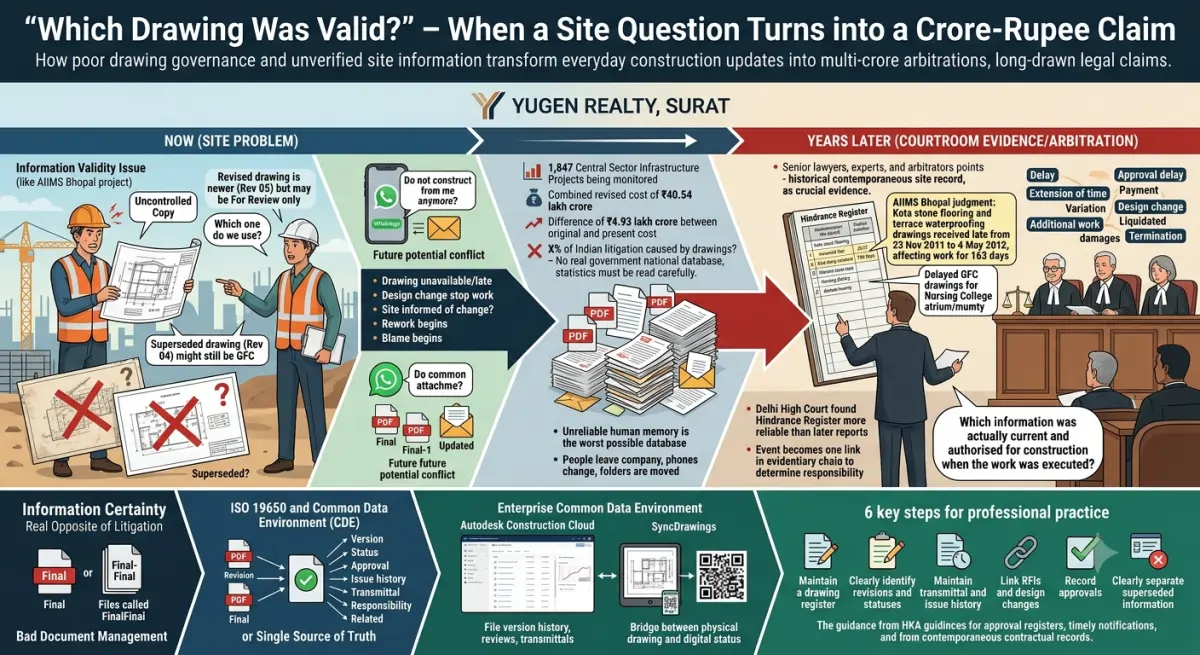
One entry recorded that the work was affected because drawings for Kota stone flooring and terrace waterproofing were received late – from 23 November 2011 to 4 May 2012, a period of 163 days. Another entry referred to delayed GFC drawings for the atrium and mumty of the Nursing College. The Court specifically noted that this Hindrance Register was a contemporaneous site record, maintained at the relevant time and signed by the concerned engineers and consultants. The arbitrator considered it more reliable than certain reports prepared later, and the Delhi High Court found no reason to interfere with that approach.[1]
One thing must be made very clear here. The judgment does not say that the entire delay on the AIIMS Bhopal project was caused only by late drawings. Several other hindrances were recorded as well.
But the case gives us a much larger lesson :
On the day the drawing was unavailable, it was merely a site problem. Years later, the same event became one link in an evidentiary chain used to determine responsibility.
And that changes the way we should look at construction drawings.

When a “Drawing” Reaches the Courtroom
We normally describe construction disputes in categories such as delay, extension of time, variation, additional work, design change, approval delay, rework, payment, liquidated damages, or termination. Court and arbitration records also usually classify disputes in this contractual language.
But what actually happened underneath those categories?
- “The revised drawing was issued late.”
- “We executed according to the drawing issued to us.”
- “That drawing had already been superseded.”
- “The site had been informed about the change.”
- “The consultant had not issued the GFC drawing.”
- “That file was only For Review.”
And a few years later, these statements turn into a completely different set of questions:
Which drawing? Which revision? When was it issued? Who issued it? Who received it? Under what status was it issued? Was it approved? Was it subsequently superseded? And most importantly – when the work was executed, which information was actually valid for construction?
These may appear to be technical questions.
Once a project enters a claim or arbitration, however, they become contractual – and sometimes legal – questions.
How Large Is This Problem in India? This Is Where Statistics Must Be Read Carefully
India does not currently have one live, government-maintained national database that classifies every pending “construction litigation” according to its construction root cause.
Therefore, statements such as :
“India has X lakh construction disputes”
or
“X% of construction litigation is caused by drawings”
may make attractive headlines, but they would not be responsible conclusions unless supported by a specific dataset.
Legal databases such as Indian Kanoon, however, can give us a sense of the judicial footprint of construction disputes.
On 12 August 2026, a search on Indian Kanoon for construction contract together with the arbitration-agreement tag returned 1,497 indexed legal documents.[2]
That number must not be interpreted as “1,497 pending construction arbitrations.”
The search results can include judgments at different stages, petitions for appointment of arbitrators, challenges to arbitral awards, citations to older precedents, and sometimes several court proceedings arising from the same underlying dispute.
So this is not a census of construction disputes.
But it does tell us something important: the judicial footprint of construction contracts and arbitration in India is neither small nor exceptional.
And if we want to understand the financial scale, even a few recent NHAI arbitration matters are revealing.
In July 2026, in the Bareilly–Sitapur highway arbitration, the concessionaire had raised 30 claims totalling approximately ₹3,177 crore. The tribunal eventually awarded ₹46 crore plus applicable interest under only three claims. The same Government release referred to the June 2026 Tumkur–Chitradurga dispute, where an award of ₹1,202 crore was made in favour of NHAI. In two Panipat–Jalandhar arbitrations, the concessionaire’s claims amounted to approximately ₹8,375 crore, while NHAI had counterclaims of ₹2,888.64 crore. In Gujarat’s Kamrej–Chalthan NH-48 matter, the contractor had claimed approximately ₹174.49 crore.[3]
These numbers also require caution.
An amount claimed is not the same as a loss proved, and drawings were certainly not the cause of all these disputes.
But the numbers establish one point very clearly: contractual uncertainty in major construction and infrastructure projects is measured not merely in lakhs or crores, but sometimes in thousands of crores.
Against that background, describing an information gap as “just a drawing-management issue” may turn out to be a very expensive misunderstanding.
How Can One Design Change Consume Three and a Half Years?
A February 2026 judgment of the High Court of Jammu & Kashmir and Ladakh in M/s D.S. Constructions v. Union of India offers another interesting example.[4]
The project involved watch towers and security infrastructure at Air Force Station Thoise.
According to the contractor’s case, work had already progressed when the Air Force authorities decided to change the design of the watch towers and instructed that further work be stopped. Revised drawings were subsequently forwarded and, according to the record, reached the contractor in March 2020.
A revised administrative approval process then followed.
Eventually, in July 2022, the contractor was informed that additional funds for the revised design had not been approved and that the work should now continue according to the original drawings.[4]
The factual narrative recorded in the judgment states that almost three and a half years were lost in this process.
Again, legal discipline is important. At that stage, the Court was deciding an application concerning the appointment of an arbitrator. It was not finally deciding that every allegation made by the contractor was correct. Liability for the underlying claims was to be determined in arbitration.
But look at the chronology as a construction professional:
Original Design → Stop Work → Revised Design → Wait for Approval → Funding for Revised Design Not Approved → Return to Original Drawings
- This is much more than “a drawing arrived late.”
- It is a failure of governance around a design decision.
Sometimes the Official Record Itself Says the Drawings Were Late
A 2024 commercial court matter from Karnataka concerning government school infrastructure projects examined disputes across several construction locations.
The record referred to admitted delays in handing over sites, issuing and finalising designs and drawings, and approving variations. At different project locations, recorded delays ranged from 171 to 467 days. The arbitrator considered delays in site handover as well as delays in issuing drawings and revised drawings among the factors preventing timely completion, and the Commercial Court found no basis to interfere with the relevant arbitral findings under Section 34.[5]
Similarly, in the Delhi High Court’s 2025 NBCC v. Sharma Enterprises matter, a decades-old dispute concerning the Vashi Railway Station-cum-commercial complex resurfaced. The underlying arbitral record noted that certain drawings were issued late, some were repeatedly revised, and some revised drawings were issued during critical periods of execution. Here too, drawings were not the only cause – delay in civil works by another contractor was also relevant.[6]
These cases are not identical.
In some, drawing delay is part of an accepted factual finding. In others, it is an arbitral finding. In yet others, it is merely one party’s allegation.
That distinction is important.
Yet across different projects, states, and time periods, the same vocabulary repeatedly appears : design change, drawing issue, revised drawing, approval, instruction – and timing.
At that point, this is no longer merely a “site communication issue.”
In a ₹40.54 Lakh Crore Infrastructure Environment, What Is Information Worth?
According to MoSPI’s PAIMANA data for June 2026, the Government was monitoring 1,847 ongoing Central Sector Infrastructure Projects costing ₹150 crore and above, with a combined revised cost of approximately ₹40.54 lakh crore.[7]
The aggregate original cost of the major and mega projects reported works out to roughly ₹35.61 lakh crore.
That means there is a difference of approximately ₹4.93 lakh crore between the aggregate original cost and the present revised cost.[7]
Once again, connecting that ₹4.93 lakh crore figure directly to drawing errors would be completely incorrect.
Land acquisition, scope change, financing, procurement, regulatory approvals, material issues, contractor performance, unforeseen conditions, and many other factors can affect time and cost.
The number serves a different purpose. It provides context.
In a country where just the monitored Central Sector infrastructure portfolio exceeds ₹40 lakh crore, the manner in which drawings, design decisions, approvals and instructions are recorded and controlled cannot be treated as a clerical filing issue.
It is a question of project governance.
The India-focused CRUX construction-dispute research published by HKA and Indian law firms also identifies design-related issues and late approvals among significant claim and dispute causation factors. The discussions include design revisions, inadequate coordination, employer-driven changes, uncertainty in approval processes, and deficiencies in design documentation.[8][9]
But even this research does not justify converting those findings into a headline such as :
- “X% of Indian litigation is caused by wrong drawings.”
- The real problem is subtler.
Not “Wrong Drawing” – But “Information Validity”
Very often, the drawing being used on site is not technically wrong at all.
Imagine this situation.
On Monday, the architect issues Revision 04 as GFC – Good For Construction.
On Tuesday, after a design change, Revision 05 is created – but its status is only For Review.
The site engineer now has both files.
Which is the “latest drawing”?
Revision 05 is chronologically newer.
But it may not yet be authorised for construction.
Revision 04 is older, but it may still be the current contractual GFC instruction.
So, the real question is not simply:
What is Latest?
The question is : What is Current and Authorised?
- A drawing can be technically perfect and yet be superseded.
- Another drawing can be newer but not yet approved.
- A third drawing may have been updated for one discipline while the MEP or structural team is still working against an older architectural background.
This is where rework begins.
This is where : “But this is the drawing I received” begins.
- This is where blame begins. And sometimes, this is where a claim begins.
- The Biggest Weakness of a PDF : It Does Not Know That It Is Dead
- An old A1 print lying on site looks just as professional today as it did on the day it was issued.
- It still has its title block.
- It still has the consultant’s name.
- It still has dimensions.
- It still has a revision number.
- But what if another revision was subsequently issued?
- The paper does not change colour and announce : “Superseded.”
A PDF sitting in the Downloads folder of someone’s phone does not disappear automatically.
A WhatsApp attachment received three months ago does not suddenly display :
“Do not construct from me anymore.”
That is one of the strangest problems of construction information :
The physical life of a document can be much longer than its contractual validity.
In an earlier discussion on the idea of a Single Source of Truth, we made light of folders containing files called Final, Final-1, Updated, and Final Final.
From a legal and contractual perspective, however, this is not really funny.
Every uncontrolled copy is a potential future conflict. Singal Source of Truth or CDE.pdf PDF
The Moment a Dispute Begins, Everyone Becomes a Historian
During construction, many events appear insignificant.
A consultant sends a sketch.
The architect asks during a meeting for a wall to be shifted.
The MEP consultant marks something in red on a PDF.
The site engineer sends a photograph on WhatsApp.
The client says on a phone call, “Go ahead.”
Someone raises an RFI.
Two days later, a revised drawing is issued.
The project moves on.
People leave the company.
Phones change.
Email accounts are closed.
Folders are moved.
Then two years later, a ₹2 crore rework claim arrives.
Suddenly everybody becomes a historian.
“What exactly happened that day?”
“Who sent this PDF?”
“Was this change approved before execution or afterward?”
“Was this markup merely a comment, or was it an instruction?”
“When did Revision 06 actually reach the site?”
“How much work had already been completed using Revision 05?”
This is where human memory becomes the worst possible database.
The Basic Principle of Standard Practice: Record the Event When the Event Happens
Perhaps the biggest lesson from the AIIMS Bhopal matter is not even the delayed drawing.
It is the value of a contemporaneous record.
The contract in that project also contemplated written notice where additional drawings, orders, directions, instructions, or approvals were required within a particular time. In other words, the contract itself recognised that when information was required and when it was received could affect project time.[1]
The basic principle of professional construction practice follows the same logic :
- Maintain a drawing register.
- Clearly identify revisions and statuses.
- Maintain transmittal and issue history.
- Link RFIs and design changes to the relevant documents.
- Record approvals.
- And clearly separate superseded information from current information.
The India-focused HKA guidance on late approvals similarly emphasises approval registers, timely notifications, clear communication, and contemporaneous contractual records during execution.[9]
This is not simply good administrative discipline.
The record that manages the project today may become evidence tomorrow.
A CDE Does Not Mean “A Folder in the Cloud”
- Under the ISO 19650 information-management framework, a Common Data Environment – CDE is described as an agreed source of information for a project or asset.[10]
- The word agreed may be more important than the word cloud.
- Putting a thousand PDFs into Google Drive does not automatically create a CDE.
- Giving everyone access to folders called Final, Final-New, Final-Client, Final-Site, and Final-R2 does not create a Single Source of Truth.
A system becomes useful when it manages not merely the file, but the validity of the file :
- version;
- revision;
- status;
- approval;
- issue history;
- transmittal;
- responsibility; and
- related communication.
This is where technology enters the discussion – not to “solve litigation,” but to create information clarity before information failure turns into a dispute.
What Technology Can Do, and What It Cannot
Enterprise Common Data Environment platforms such as Autodesk Construction Cloud today provide capabilities such as file version history, reviews and approval workflows, transmittals, document comparison, markups, and issue tracking. Autodesk’s documentation, for example, allows teams to review different file versions, compare documents, see review status, and retain approval-workflow history.[11]
A more drawing-centric implementation of the same principle can be seen in platforms such as SyncDrawings, where the idea is to connect a printed or digital drawing with its live record – whether it is Current or Not Current, its revision history, changelog, related drawings, and issues associated with that drawing.
Here, a QR code is not valuable merely because it provides a faster way to download a PDF.
Its real potential is to become a bridge between a physical drawing and its live digital status. Single Sourse of Truth or CDE.pdf PDF Information, Not Drawings, is the Future of Indian Construction.pdfPDF
- But the limitations of technology are equally important.
- Scanning a QR code does not make a drawing contractually approved.
- Software can only display an approval that has actually been created through an authorised project process.
- A CDE cannot turn bad design into good design.
- Version control cannot prevent poor workmanship.
- And even the most expensive document-management platform is of little use if critical project decisions are still being made outside the system through WhatsApp messages and verbal instructions.
So, whether the platform is ACC, SyncDrawings, or something else is not the central question.
The central question is :
Does the project possess a reliable chronology of its information?
The Real Opposite of Litigation Is Not Software – It Is Information Certainty
Construction disputes will never disappear completely.
Land, payments, scope, finance, materials, procurement, labour, unforeseen conditions, quality, contract language and many other issues will continue to create disagreements.
That is why claiming that any digital platform can “eliminate arbitration” would be an exaggeration.
But some disputes should never reach the point where, years later, senior lawyers, experts and arbitrators have to search through thousands of pages merely to answer a basic question:
“Which drawing was actually valid when this work was executed?”
That answer should be available on the site on that very day.
- Which revision was used?
- Who issued it?
- What was its status?
- What changed?
- Which version came afterward?
- These should not become future legal-research exercises.
- They should be part of everyday construction management.
At AIIMS Bhopal, a years-old Hindrance Register was able to “speak” in court because someone had recorded the event when it happened.
In today’s digital environment, we can apply the same principle much more powerfully.
- Keep the history alive with every drawing.
- Keep the context with every revision.
- Keep the authority with every approval.
- And keep the evidence with every change.
Because the cheapest construction dispute may not be the one, we successfully win in arbitration.
The cheapest dispute is the one that never gets the chance to begin before the concrete is poured.
______________________________________________________
Disclaimer : This information has been collected through secondary research and Yugen Realty Newspaper is not responsible for any errors in the same.
Read more news including local, national, international, business on Yugen Realty Newspaper. Join us on social media to stay updated with the latest news.
FACEBOOK | INSTAGRAM | LINKEDIN | TWITTER | PINTEREST | YOUTUBE | WHATSAPP CHANNEL | TELEGRAM
Related Posts

ICEA Sthapatya 2026 : South Gujarat’s Premier Expo for Building Materials, Architecture, Interiors & Construction Solutions
CM Bhupendra Patel Visited The Akhilam Mega Township Project of GAP Group