



Estimated reading time: 9 minutes
YUGEN REALTY, SURAT
Surat’s Hospitality Experience
Surat is entering a new hospitality phase. The city’s strength in diamonds, textiles, manufacturing, trade and entrepreneurship has always fuelled business travel, but its hotel market is now expanding around branded stays, social events, food and beverage, meetings and transportation demands.
Hilton Garden Inn Surat City Centre opened in 2025, while IHG has announced the 110-key Holiday Inn Express Surat Gauravpath for 2029. Along with these visible additions, many national and international brands are moving into new properties in the city.
This growth brings opportunity, but also a tough performance benchmark. An attractive facade, impressive lobby and well-designed rooms can attract attention and even drive first bookings.
However, lasting business results depend on what happens after check-in: Does the room cool quickly, the air feels fresh, the shower is reliable, the restaurant remains odour-free, the Wi-Fi and lighting work, and critical systems remain operational during disruptions.
Guests rarely see the chiller, VRF outdoor unit, pump room, electrical panel, sewage-treatment plant, or fire command center. Yet they experience the combined performance of these systems every minute.
This is why mechanical, electrical, plumbing, and fire-protection engineering shouldn’t be treated as a backend package. For a hotel, MEPF is the property’s operating system.
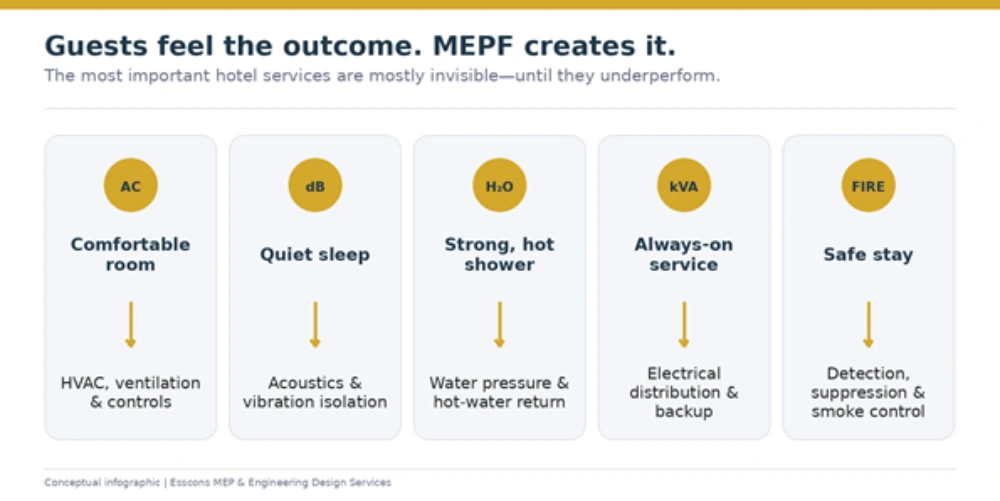
Infographic 1 | The visible guest experience is largely created by invisible engineering systems.
“A beautiful hotel attracts first bookings; consistent comfort gets second bookings.”
1. HVAC : Comfort is more than temperature
Surat’s heat, humidity, and monsoon conditions make hotel HVAC design a comfort and moisture-management challenge, not just a matter of calculating tons of cooling. Temperature, relative humidity, ventilation, filtration, room pressure, odour migration, equipment noise, and condensate disposal must all work together.
Hotels also have very different load profiles under the same roof. Guest rooms have periodic occupancy. Lobbies are open for long hours. Restaurants and kitchens create heat and exhaust loads.
Ballrooms can go from nearly empty to full occupancy in a short time. Gyms, spas, offices, and back-of-house areas require different operating schedules. The same design assumptions applied everywhere lead to either discomfort or excessive energy consumption.
The correct answer is zoning, part-load efficiency, and control. Guest rooms need quiet terminals and individual controls; Public areas need to be kept cool despite door openings and circulation; banquet systems need to be responsive; kitchens need balanced exhaust and replacement air so that odours don’t migrate into dining or lobby areas. Plant and equipment selection should be based on annual operating behaviour, maintenance, and redundancy—not just peak-load capacity.
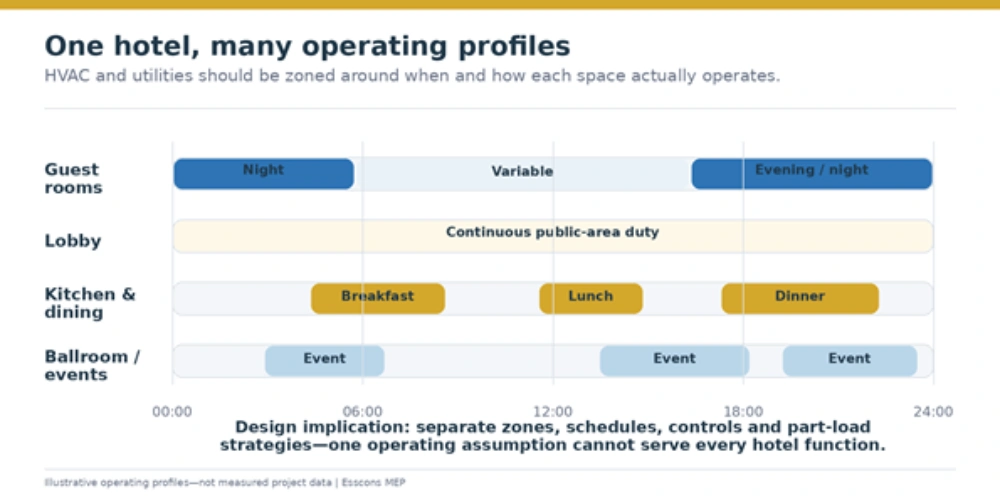
Infographic 2 | Example operating profiles show why guestrooms, public areas, kitchens, and event spaces need separate zoning and control.
2. Water : A basic service that provides guests with immediate notice
Hotel guests value water as a service promise. Hot water should arrive quickly, shower pressure should remain consistent across floors, and temperatures should not fluctuate as occupancy increases.
Delivering this consistently requires pressure zoning, appropriately sized storage and generation, balanced hot water recirculation, intelligent pipe routing, access to source-appropriate water treatment, and maintenance.
Water efficiency should also be planned for. Low-flow fixtures, metering, leakage monitoring, treated-water reuse, and a properly designed sewage-treatment system can reduce consumption without impairing the guest experience.
Where technically feasible and permitted, reuse for flushing, landscaping, or cooling-tower make-up should be considered. Odour control is equally important: soil and waste heaps, grease traps, kitchen drains, STP ventilation, and service yards should be located and integrated so that hidden drainage decisions never become a complaint against the homeowner.
3. Electrical Reliability and Intuitive Room Controls
For hotels, electrical reliability is not just about keeping the lights on. It includes safe and selective distribution, properly assessed diversity, reliable backup for critical services, clean power for IT and controls, emergency lighting, earthing, lightning protection, and maintainable routing.
The backup philosophy should be agreed with the operator early on: what functions should be performed during an outage, for how long, and in what order?
Room lighting and controls are also part of the brand experience. GRMS, key-card or occupancy logic, master controls, and dimming scenes should feel intuitive to guests while reducing unnecessary usage in unoccupied rooms. Submetering by key end use allows the operating team to separate a real efficiency issue from a change in occupancy or event load.
4. Fire and life safety must operate as a system.
Fire and life safety cannot be layered on top of a complete design. Detection, alarms, sprinklers, hydrants, smoke management, stair or lobby pressurization, emergency power, exit interfaces, fireman communications, and kitchen safety must operate as an integrated strategy under applicable codes and authority requirements.
The most useful test is a cause-and-effect matrix: When a detector, sprinkler flow switch, kitchen suppression system, or manual call point operates, what should happen to the alarm, elevator, access-controlled doors, air-handling units, smoke-control fans, and emergency announcements?
If the interface remains unclear until installation, individual systems may pass separate tests but fail to behave as a single life-safety system.
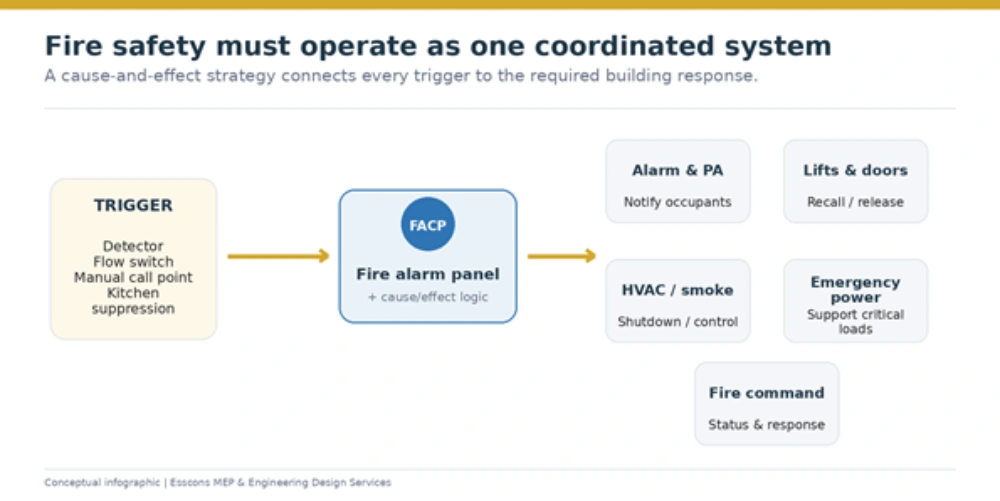
Infographic 3 | Fire alarms only become a life-safety strategy when all necessary building responses are coordinated and tested.
“The most expensive MEP corrections are usually made after the hotel opens.”
5. The most expensive problems start in planning
Many hotel MEP problems start before equipment is selected. Shafts are made smaller to gain marketable or usable space. Plant rooms lack service clearances. Ducts, pipes, cable trays, and access panels cannot be accommodated in the ceiling zone. Kitchen exhaust routes are considered after the upper floor plan is finalized.
Laundry heat and humidity are underestimated. DG exhaust, cooling towers, or STP vents conflict with the guest rooms, terraces, or arrival experience.
These are expensive improvements because they simultaneously affect the architecture, structure, operation, and program. The solution is early integration : Hospitality operator, architect, structural consultant, kitchen and laundry specialists, interior designer and MEPF consultant should agree on design criteria during concept development.
Integrated models, representative guest-room and restroom mock-ups and planned maintenance routes resolve issues while they are still affordable to change.
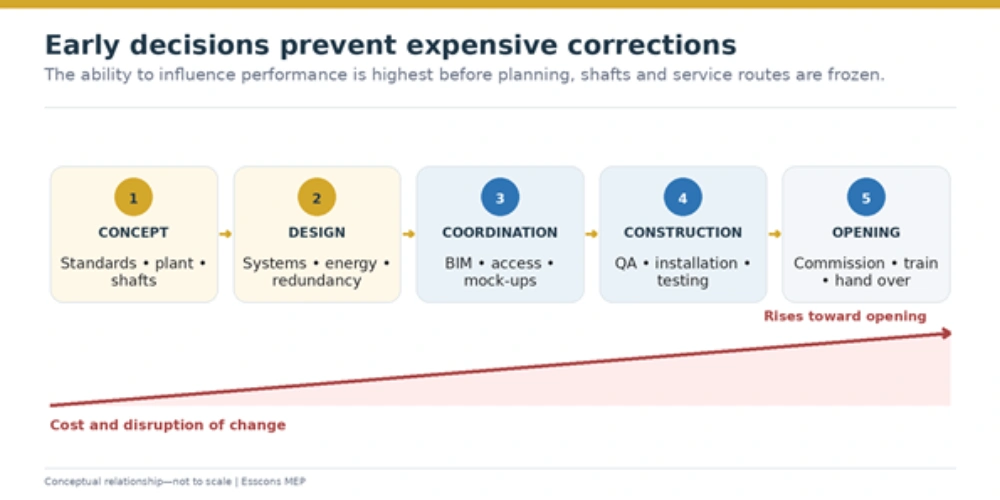
Infographic 4 | Early integration maintains design flexibility; disruption created by late changes increases the risk of exposure.
6. CAPEX must be tested against life cycle performance
Hotel value engineering should optimize life cycle value, not just eliminate upfront costs. A low-cost pump, fan, control package or electrical configuration may look attractive at the time of purchase but can lead to increased energy consumption, maintenance, noise, downtime or replacement costs over the years.
True comparisons include efficiency at actual part load, equipment life, local service support, spare availability, redundancy, water consumption, and the financial impact of unavailable rooms or banquet space. BMS and GRMS can strengthen this lifecycle approach when they are designed around operational decisions.
Useful systems display trends, alarms, energy and water consumption, equipment runtime, and abnormal conditions in a form that the engineering team can act on. Smart technology is not the number of sensors installed; it is the quality of decisions enabled by the system.
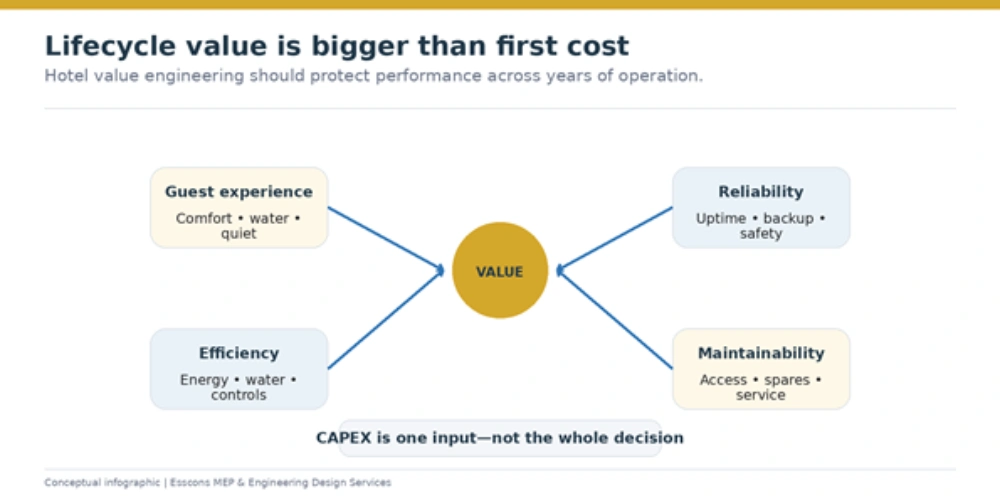
Infographic 5 | Lifecycle value connects guest experience, reliability, efficiency, and maintainability—not just initial capex.
7. Commissioning is part of opening readiness
Design intent does not automatically translate into operating performance. Before opening, a hotel should undergo systematic testing, alignment, and balancing; pressure and leakage tests; electrical safety checks; emergency-power tests; fire-alarm and smoke-control integration tests; hot-water delivery checks; acoustic and vibration reviews; BMS sequence validation; and operator training.
Testing should simulate real-world conditions, including peak banquet occupancy, simultaneous morning hot-water demand, kitchen operations, and general power outages.
This process also requires documentation: approved design criteria, equipment schedules, test records, as-built information, operating sequences, system guidelines, and a clear fault-closing procedure.
Opening-day urgency is understandable, but bypassing integrated commissioning transfers unfinished engineering to live hotel operations, where improvements are slower, more visible, and more expensive.
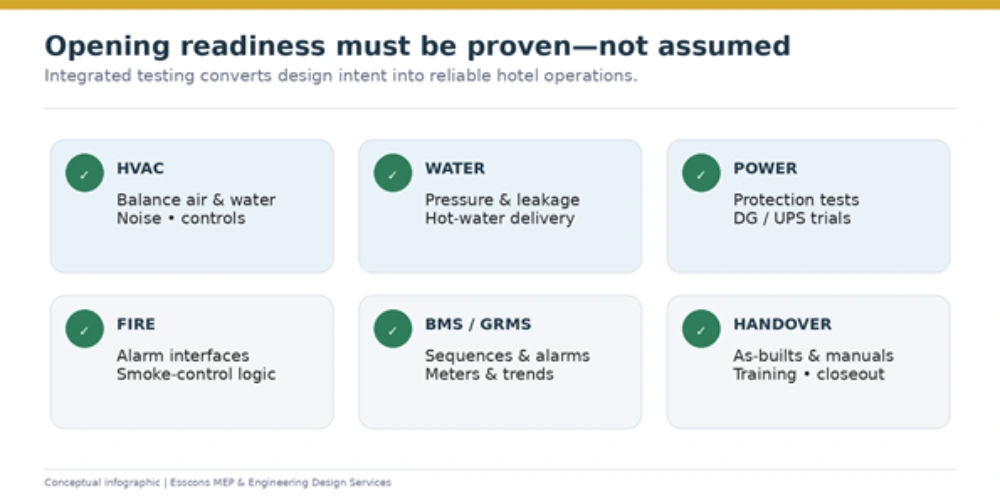
Infographic 6 | Opening readiness requires integrated verification across HVAC, water, electrical, fire, controls, and handover documentation.
Six decisions developers should make early
- Define functionality. Stabilize operator technical standards and owner priorities before schematic design.
- Integrate early. Appoint the MEPF team at the concept stage – not after planning and roof zones are determined.
- Secure service space. Reserve adequate shafts, plant rooms, roof zones, and maintenance facilities.
- Assess lifecycle value. Compare key systems on energy, water, maintainability, redundancy, and downtime – not just on purchase price.
- Coordinate operational zones. Use integrated models and mock-ups for guest rooms, restrooms, kitchens, banquets, laundry, and back-of-house areas.
- Prove readiness. Condition the opening with integrated testing, documentation, and operator training.
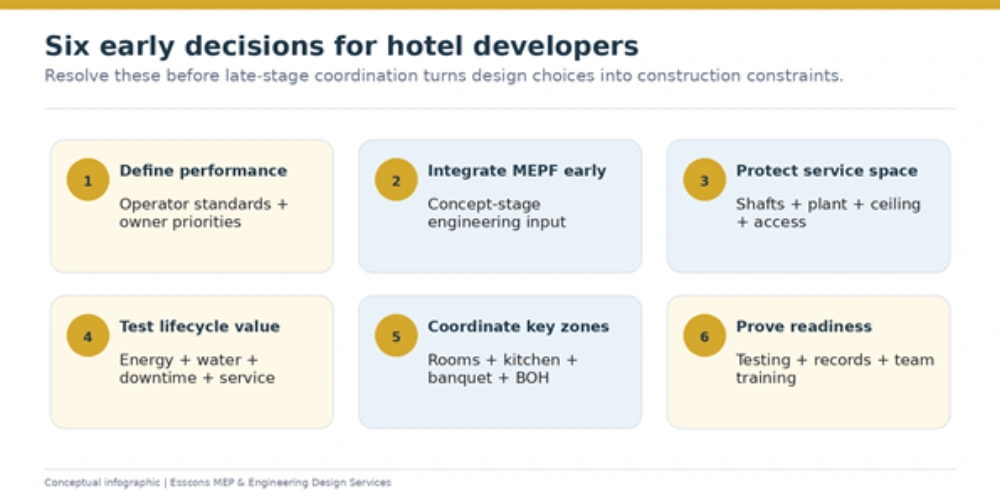
Infographic 7 | Six developer decisions that protect comfort, integration, lifecycle value, and readiness for opening.
The engineering behind the experience
Surat’s hospitality expansion is a strong indication of the city’s economic maturity. The next generation of hotels will compete on architecture, service, food, brand, and location – but engineering will connect them all. The properties that will consistently perform will be those where comfort, safety, energy, water, maintenance, and resilience were designed as a system from the start.
Selected ongoing hospitality MEPF design assignments
(Approved for public mention by Askons.)
______________________________________________________
Disclaimer : This information has been collected through secondary research and Yugen Realty Newspaper is not responsible for any errors in the same.
Read more news including local, national, international, business on Yugen Realty Newspaper. Join us on social media to stay updated with the latest news.
FACEBOOK | INSTAGRAM | LINKEDIN | TWITTER | PINTEREST | YOUTUBE | WHATSAPP CHANNEL | TELEGRAM