


YUGEN REALTY, SURAT
When discussing the fastest-growing cities in India, Surat today stands at the forefront. Diamond, textile, manufacturing, port-based industries, the MSME sector, and a strong business culture have transformed Surat not only into Gujarat’s but also one of the country’s most powerful economic hubs.
However, despite such extraordinary potential, one major question still arises today – is Surat developing according to its true capability?
- Surat Now Needs Not Just Growth, But Visionary and Planned Development
- ₹7,000 Crore of Real Estate Investment Stalled
- Some Pending TP schemes Stuck for 26 Years
- Slow Approvals and Stalled Planning – The Biggest Barrier to Surat’s Growth
- Industry-Government Coordination Will Make Surat India’s Next Urban Powerhouse
Today, Surat has everything : some of the country’s strongest industries, world-class connectivity, the Bullet Train, Metro, Dedicated Freight Corridor (DFC), Dream City, Surat Special Investment Region (SIR), the Hazira industrial zone, international airport expansion, multi-modal transport hub, Tapi Riverfront, Dumas sea-front, and mega projects like PM Mitra Park. Yet, despite all these large-scale developments, the city’s growth appears to be losing momentum in many areas.
The reason is clear – Surat still lacks the level of planned urban development, fast execution, and the integrated industry-government approach that a city with such global potential truly deserves.
The real estate sector does not just build buildings – it shapes the future of a city.
Even today, the real estate sector is often viewed merely as a “construction industry.” But in reality, real estate forms the foundation of a city’s overall economy, employment generation, and infrastructure development.
A single project does not just create a tower. Along with it come roads, water supply, drainage systems, electricity, commercial activity, transportation, employment, retail, schools, hospitals, and the future of thousands of people.
The real estate sector directly and indirectly drives more than 250 industries: cement, steel, HVAC, elevators, electricals, glass, sanitaryware, paints, interiors, machinery, logistics, labour markets, technology, and the service sector. Therefore, when real estate slows down, it is not just projects that stop – the entire city’s economy begins to lose pace.
The biggest obstacle in Surat’s development – stalled planning and a slow approval system. More than ₹7,000 crore worth of investment stuck due to TP schemes
Discussions within industry circles suggest that more than ₹7,000 crore worth of investment has been stalled due to delayed files and pending TP schemes in Surat’s construction sector.
This is not merely a loss for developers or landowners; it is a serious concern for the city’s entire economy, employment generation, investment flow, and overall pace of development.
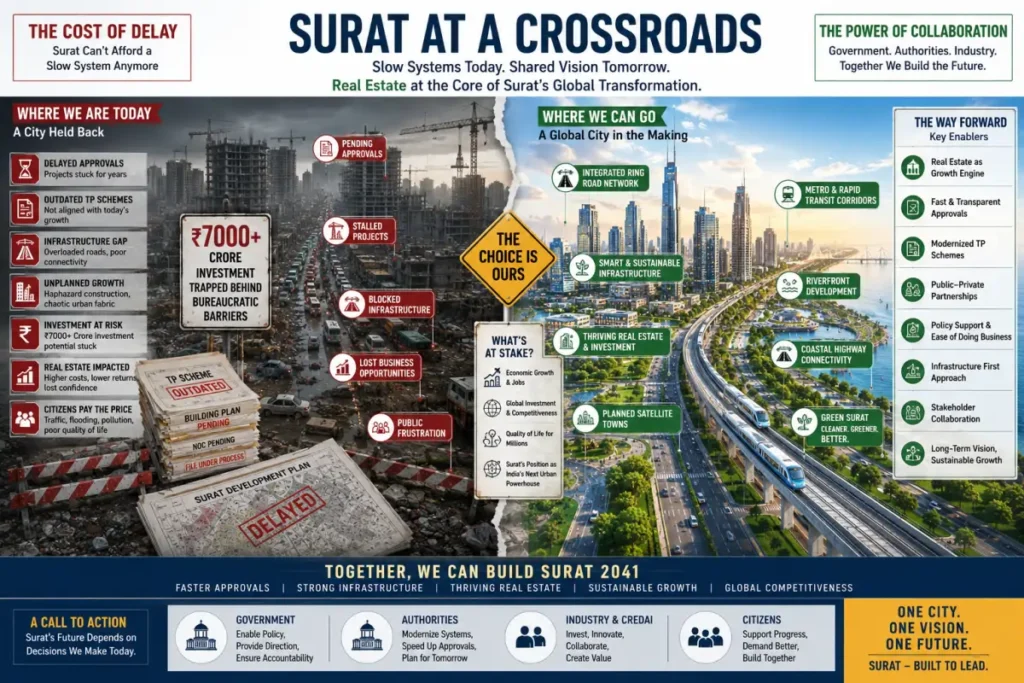
The most persistent grievance is the gap between the promise of “time-bound approvals” and ground realities. Government directives mandate resolution of various issues within 90 days, but many cases drag on for years.
Plan approvals routinely take 10–15 months. Developers must chase multiple No Objection Certificates (NOCs) across departments with endless follow-ups.
Town Planning (TP) schemes remain pending for years, road alignments stay unresolved, and clear policy direction for industries and real estate developers remains elusive. Several long-standing builder-related issues are still awaiting resolution at various government levels.
The Endless Cycle of TP Scheme Revisions
A major pain point is the Town Planning process itself. SUDA and the Municipal Corporation invest significant effort in preparing TP schemes, finalizing land deductions, and allocating Final Plots (FP) even at the Draft TP stage. Yet, newly appointed Town Planning Officers (TPOs) frequently reopen finalized matters, leading to repeated modifications.
Common observations include :
- New officials joining during the Preliminary TP stage after Draft TP completion.
- Previously settled issues being revised without fresh objections.
- Transfers of key officials before schemes reach final sanction.
This lack of continuity and consistency breeds uncertainty. Projects worth thousands of crores stall. Investors hesitate. Development momentum in emerging areas slows dramatically.
The real estate fraternity strongly feels that greater transparency, strict timelines, and accountability in the TP process are no longer optional – they are essential for Surat’s progress.
TP Schemes Pending for Decades
Industry insiders point out that some TP schemes in Surat have remained unresolved for 20 to 26 years. In certain cases, delays stem from pending data from GIDC, while others face complications related to river boundaries, embankment planning, and alignment disputes.
The consequences are tangible :
- Massive investments remain locked.
- Critical road networks stay incomplete.
- Development in peripheral and new growth corridors decelerates.
- Investor confidence erodes steadily.
Despite the 13-10-2019 government circular directing 90-day resolution for Development Plan and TP-related matters, many issues persist far beyond that window – sometimes exceeding 900 days. Surat’s 2004 Development Plan was expected to conclude by 2014 but received only tentative approval in 2017. Even today, several legacy issues remain unaddressed.
Key concerns include unclear development planning around the airport, decade-old reservations that have not been revisited, and restricted utilization of land in the Green City area (beyond the Diamond Bourse project). In satellite town regions, government-fixed land rates significantly exceed market realities, discouraging momentum. These bottlenecks affect not just real estate but the city’s overall economic and infrastructural future.
Development Plan 2035 : Still a Work in Progress
The ambitious Development Plan 2035, vital for guiding Surat’s growth, is yet to be fully implemented. Thousands of objections, suggestions, and representations await resolution. In many localities, residential and commercial development has already occurred organically, but formal zoning and road network clarity are missing.
This mismatch leads to :
- Heightened uncertainty for investors.
- Cautious lending by banks.
- Stalled projects.
- Unplanned urban sprawl.
- Mounting pressure on future infrastructure.
- Without timely clarity, Surat risks expanding in a fragmented manner that will prove costly to correct later.
Reclassification of Town Planning Villages : A Major Setback
Another pressing issue is the reclassification of several villages – previously included under town planning and brought under SUDA – back into agricultural zones.
In areas where people already reside and construction has taken place, this shift creates practical hardships :
- Severe difficulties in securing bank financing.
- Depressed land valuations.
- Halt in legitimate development activities.
- Confusion and uncertainty among investors and residents.
The industry urges authorities to align such decisions more closely with existing ground realities rather than rigid administrative categorizations.
Dumas Beach Progress vs. Coastal Highway Delays
On a positive note, Dumas and surrounding coastal areas have seen encouraging development. Sea-facing and nature-oriented projects are gaining popularity. However, the alignment of the Coastal Highway remains unclear.
Complications involving rivers, embankments, and coastal regulatory boundaries create long-term planning uncertainty. Advance, clear infrastructure vision is crucial here to prevent future unplanned growth and environmental challenges.
Learning from Ahmedabad’s Success
Ahmedabad offers a compelling blueprint for Surat. The city boasts two operational ring roads, with a third under development. Its structured zoning (R1, R2, R3), proactive satellite town planning, and forward-looking road networks demonstrate what consistent, visionary execution can achieve.
In contrast, Surat’s Ring Road-1 is still incomplete, while the Outer Ring Road has lingered in proposal stages for years. As the city expands rapidly, its infrastructure particularly road networks and connectivity has not kept pace. TP schemes often obstruct road development, alignment issues persist, and preparedness for future traffic demand remains inadequate.
The comparison is not about competition between cities but about Surat receiving the timely, planned infrastructure it deserves to match its growth trajectory.
Voice of the Industry

Sanjay Mangukia, Chairman, CREDAI Surat emphasizes : “Surat has exceptional potential to become India’s next global urban and economic powerhouse. But development cannot happen through infrastructure announcements alone. A time-bound approval system, faster TP implementation, planned road networks, and stronger coordination between industry and government have now become essential. The real estate sector must be seen not just as a construction industry, but as a co-creator of the city’s future.”
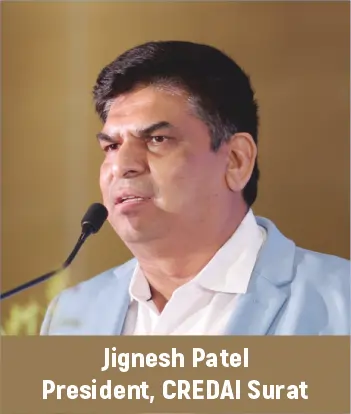
Jignesh Patel, President, CREDAI Surat adds : “Surat today is one of India’s strongest growth engines. If issues related to the Development Plan, TP schemes, ring roads, satellite towns, and infrastructure are resolved in a time-bound and visionary manner, Surat can become a benchmark for urban development not just in Gujarat, but across the entire country. Now is the time for the government, authorities, and industry to move forward with a shared vision.”
The Imperative for Collaborative Development
Surat’s progress cannot be driven by the government in isolation, nor by the industry alone. A robust collaborative model is the need of the hour. CREDAI Surat has consistently highlighted practical challenges related to TP schemes, zoning, road networks, approvals, and infrastructure.
Active industry involvement can make planning more realistic, accelerate execution, reduce red tape, boost investor confidence, and strengthen Public-Private Partnership (PPP) outcomes.
Surat Development Plan 2041 : A Historic Opportunity
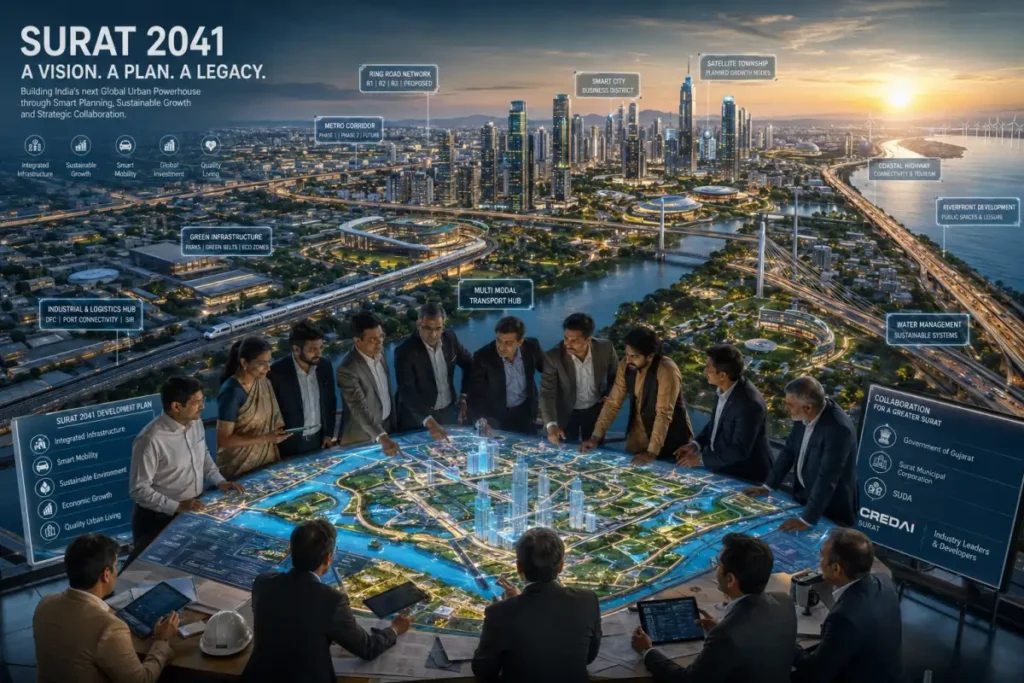
The ongoing work on the Surat Development Plan 2041 presents a golden chance to break from past patterns. This plan must be grounded in reality – time-bound, implementation-oriented, and developed with active industry participation.
Priority areas should include :
- Comprehensive ring road and outer connectivity.
- Integrated multi-modal transport systems.
- Metro and rail corridor development.
- Sustainable coastal and riverfront management.
- Green infrastructure and urban flood mitigation.
- Balanced industrial – residential growth.
- Smart, future-ready zoning for satellite towns.
- Towards Visionary Development
Surat possesses immense economic strength, a vibrant trade culture, a strong industrial foundation, and dynamic energy. What it requires now is not mere development, but visionary development. This calls for fast decision-making, transparent approval mechanisms, robust infrastructure planning, and deep trust-based collaboration between government, authorities, institutions like CREDAI, the real estate industry, and citizens.
The real estate sector should be viewed not merely as a revenue source but as a strategic partner in city-building. When all stakeholders align in the same direction, Surat’s potential to shine as India’s next global urban success story will be fully realized. Yugen Realty remains optimistic that with focused reforms and collective will, Surat can overcome current bottlenecks and script a future worthy of its ambitions.
______________________________________________________
Disclaimer : This information has been collected through secondary research and Yugen Realty Newspaper is not responsible for any errors in the same.
Read more news including local, national, international, business on Yugen Realty Newspaper. Join us on social media to stay updated with the latest news.
FACEBOOK | INSTAGRAM | LINKEDIN | TWITTER | PINTEREST | YOUTUBE | WhatsApp Channel | Telegram
Related Posts

Igbc green gujarat summit 2025 a new path towards net-zero and sustainable development
Sanjay sheth and ajay daulatani a journey of trust & innovation In surat’s real estate