


Estimated reading time: 5 minutes
YUGEN REALTY, SURAT
A Will is a legal document through which a person expresses how his or her movable and immovable properties should be managed and distributed after death. It represents the wishes of the deceased and comes into effect only upon the death of the person making the Will (the Testator).

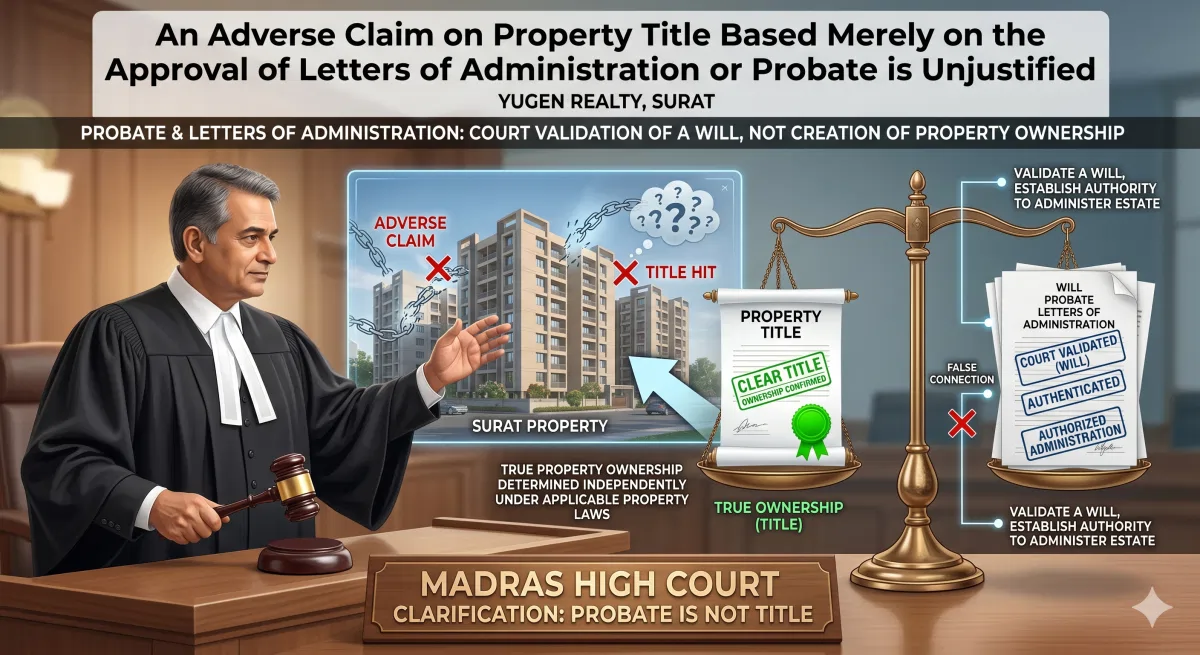
Under law, a Will may appoint beneficiaries and an executor to administer the estate. However, it is important to understand that merely obtaining a Probate or Letters of Administration does not automatically make the beneficiary the owner of the property. Probate and Letters of Administration are not documents that confer title to property; rather, they are legal instruments that authorize the administration of the estate in accordance with the Will.
A Probate or Letter of Administration is essentially a court order that confirms the authenticity and validity of a Will. It grants authority to the executor or administrator to manage and distribute the estate but does not itself create ownership rights or establish title over the property.
Madras High Court Clarifies the Legal Position
This principle was reaffirmed by a Division Bench of the Madras High Court in the case of G. Sabari Manikandan vs. S. Rathinavelu & Others (Original Side Appeal No. 253 of 2021, decided on August 1, 2022), reported in Land Laws Judgments, Volume 2, Issue 8, August 2023, Page 601.
Brief Facts of the Case
The disputed property had originally been purchased through a registered sale deed in the name of the appellant’s father. The appellant’s maternal grandfather, K. Shanmugam, was the father-in-law of the appellant’s father, S. Ganesan. Subsequently, K. Shanmugam allegedly executed a Will in favour of his son, S. Rathinavelu, who was the appellant’s maternal uncle.
Earlier, the appellant’s father had filed a civil suit seeking declaration of rights over the property. However, he later withdrew the suit and filed affidavits declaring that he had no interest in the property. Through these actions, he effectively relinquished any claim over the property.
After the death of K. Shanmugam in 2001, S. Rathinavelu filed proceedings seeking Letters of Administration based on the alleged Will. All interested parties, including the appellant, were made parties to the proceedings.
The appellant challenged the grant of Letters of Administration on several grounds. He argued that K. Shanmugam had no authority to execute the Will because the transaction was allegedly hit by the provisions of the Benami Transactions (Prohibition) Act, 1988. It was also alleged that fabricated affidavits of consent from the appellant’s father had been produced during the probate proceedings.
The appellant subsequently filed a civil suit seeking declarations concerning property rights and later sought revocation of the Letters of Administration granted in favour of S. Rathinavelu.
Findings of the High Court
The Madras High Court held that :
- S. Ganesan had already relinquished any rights he may have had in the property.
- By doing so, he had also given up his right to oppose the grant of Letters of Administration.
- The appellant did not possess any independent legal right to challenge the grant of Letters of Administration.
More importantly, the Court reiterated a well-settled principle of law :
The grant of Probate or Letters of Administration does not confer title to property.
The Court observed that while granting Probate or Letters of Administration, the probate court is concerned only with examining whether the Will is genuine and whether the legal requirements governing its execution have been complied with. The probate court does not decide questions relating to ownership or title of the property.
Legal Principle Established
- The judgment reinforces the settled legal position that:
- Probate and Letters of Administration are judicial confirmations of the authenticity and validity of a Will.
- They authorize the executor or administrator to administer the estate of the deceased.
- They serve as proof that the Will has been legally recognized by the court.
- They do not determine ownership rights or confer title over the properties mentioned in the Will.
In other words, a Probate or Letter of Administration establishes the authority to administer an estate, but questions relating to ownership and title must be determined independently under applicable property laws.
Conclusion
The decision of the Madras High Court makes it clear that a Probate or Letter of Administration is essentially a court-certified validation of a Will. It confirms that the Will is genuine and legally enforceable. However, it should not be misunderstood as a document that creates ownership rights or vests title in the beneficiary.
For property owners, legal heirs, and real estate professionals, understanding this distinction is important. While Probate and Letters of Administration facilitate the administration of an estate, disputes relating to title and ownership remain separate legal issues that must be adjudicated independently.
Source : Najmuddin Meghani – Land Laws Judgments, Volume 2, Issue 8, August 2023, Page 601.
______________________________________________________
Disclaimer : This information has been collected through secondary research and Yugen Realty Newspaper is not responsible for any errors in the same.
Read more news including local, national, international, business on Yugen Realty Newspaper. Join us on social media to stay updated with the latest news.
FACEBOOK | INSTAGRAM | LINKEDIN | TWITTER | PINTEREST | YOUTUBE | WhatsApp Channel | Telegram
Related Posts

Section 53(a) Of The Transfer of Property Act Does Not Vest Any Title In The Person Who Takes Possession By Deed
Aadhar Housing Finance raises nearly Rs 900 crore from anchor investors