




Estimated reading time: 10 minutes
Some architects build buildings, while others create spaces that are connected to time, culture and human experiences. For them, architecture is not just about walls, form and function, but becomes the identity of a place and a living connection from past to future.
Architect Sumesh Modi is one such creator who has embraced architecture not just as a profession but as an ideology for the last 27 years.
Through Modi Associates, he has contributed to institutional, healthcare, industrial, residential and commercial projects, while through People for Heritage Concern, he has worked for the conservation of Gujarat’s historical heritage.
In Yugen Realty’s ‘The Design Vanguard : Inside The Creators’, we present their inspiring journey — where they don’t just build buildings, but preserve history, understand the identity of a place, and create a meaningful architectural legacy for generations to come.
YUGEN REALTY, SURAT
Journey from Vyara to the world of architecture
Sumesh Modi started from a small town Vyara. The family business was connected to the pavilion sector, where he experienced space, colour, proportion and design closely from a young age.
Mathematics was his strongest subject during his studies in the science stream. Despite scoring 150 out of 150 marks in Mathematics in Standard 12, his journey was not easy. The turn towards architecture came from a career guidance program and an attraction to the creative field.
He got admission in architecture at VNIT Nagpur (then Visvesvaraya Regional Engineering College) outside Gujarat, but initially the language became the biggest challenge.
For a student who came from Gujarati medium, the Marathi environment, English education and Hindi dialogue — all three languages were unknown.
He failed in almost every subject in the first exam, but his perfect marks in Mathematics proved one thing that there was ability, only the medium was a barrier.
A sentence from his teacher changed his direction : “Language is just a tool of expression, not a measure of your intelligence.” The hard work that started there not only made him successful, but also made him a university topper and a gold medalist.
Design starts with the site, not the drawing board
Sumesh Modi’s design philosophy is based on three main pillars — site, identity and natural experience. According to him, fulfilling the needs of the client is the responsibility of every architect, but the real challenge is in understanding what the site itself demands.
- From which direction does the wind come?
- How does natural light enter?
- What does the surrounding environment say?
- What is the identity of the land itself?
Only after answering all these questions does design take shape. He is greatly influenced by the site-based ideology of the great Indian architect Charles Correa and B.V. Doshi’s ideas of “heterogeneous homogeneity” — that is, a building should have a distinct identity but not feel different from its environment.
This same philosophy is also reflected in his design approach. He believes in the depth of natural materials and colours, where colour is used not just for appearance but to create an experience and emotion.
In his words : “A building is not just for today, but for generations to come. It should not be just a structure, but an art that lives with time.”

Balancing creativity and function
In today’s world, when architecture is often limited to appearance or maximum FSI, Sumesh Modi believes that three partners have equal responsibility for good design :
- Architect – idea and direction
- Client/developer – trust and quality
- Site – context, features and constraints
He believes that the architect’s job is not just to meet the client’s needs, but also to provide the right guidance. “It is not necessary to use every square foot. Sometimes, more value can be created by creating less space.”
Heritage means preserving the past and connecting it with the future
The most important chapter of architect Sumesh Modi’s work is heritage conservation. His three-year research on Champaner-Pavagadh played a significant role in making Gujarat the first UNESCO World Heritage Site.
He considers this achievement to be the “Oscar” of architecture, as only one nomination is sent from each country every year.
The restoration of Surat Fort is also a great example of his ideology. This project was not just about repairing the walls, but an attempt to revive the 600-year history of Surat.
The different historical layers of Surat Fort were understood by getting information from the British Library, Dutch Archives, National Archives and research sources from around the world.
This project received national recognition under the Smart City Mission of the Government of India. According to him : “Heritage is alive only when it connects with today’s society. Not just a preserved building, but a building in use becomes a true heritage.”
The joy of transforming imagination into reality
For Sumesh Modi, the most beautiful moment in architecture is not on the drawing board, but on the site.
When an idea that was born in his mind a year ago stands in front of him in real form, that moment gives him new energy again. But for him, true success is not just a beautiful building.
Years later, when he goes to a project he has designed and sees that people are using the space in the same way that it was designed with the idea in mind — then he feels that the design has succeeded.
He says : “Architecture is not a matter of imposing on a person. It should naturally connect with their lifestyle, culture and needs.”
When it is not a need, but a dream
For Sumesh Modi, every project begins not with the client’s demand, but with understanding their lifestyle and dreams.
A prime example of this is the project of Himanshu Patel, Chairman of HLE Glascoat Limited. There was no specific requirement on a 600 sq. m plot, just a desire to create something unique.
Sumesh Modi interacted with each member of the family and tried to understand their expectations. From this idea, a unique concept was born that gave a resort-like feel — in which a garden, a tavern, a swing, an underground party area, an under-pool area, and a 22-foot pillarless cantilever studio were designed.
The client said, “Having worked with many architects, for Sumesh Modi, the right design is the one that fulfills the client’s needs and also gives a new direction to their imagination.
Green building is not just for certificates, but a truly green idea
In today’s time, when terms like sustainability and green building have become popular, Sumesh Modi’s approach is a little different. He believes that true green architecture is not just about getting certificates.
Natural light, ventilation, use of local materials and low energy consumption — these are the basics that make a truly sustainable design.
He has a personal dream: to one day build a mansion or a landmark project made entirely of lime — without the use of RCC.
He explains that our traditional lime structures have lasted for centuries, while many modern structures have a limited lifespan. Looking to the future, he believes in finding solutions from the understanding of the past.
An architect’s journey : Three stages of development Phases
Sumesh Modi sees the journey of an architect in three important phases.
- According to him, the first 10 years are a time of learning, building one’s identity and understanding and fulfilling the client’s expectations with responsibility.
- The next phase is one of experience, confidence and creative courage — where the architect does not just follow the client’s words, but has the ability to show them a better direction based on his knowledge and experience.
- The final phase is where the architect’s thinking and working method itself becomes a benchmark. He humbly believes that this is a continuous journey of development, where each new project offers an opportunity to learn, experiment and create more meaningfully.
Modi Associates : A journey of diverse creation
Modi Associates has created significant and diverse projects in various fields in the last 27 years. Large-scale institutional projects like universities, colleges, schools, hospitals and healthcare infrastructure have been their special hallmark.
Sumesh For Modi, such projects are not just about designing buildings, but about creating campuses and experiences that will last a lifetime.
Modi Associates’ specialty lies in its holistic approach — where a complete design solution is provided under one roof, from land utilization, planning, permissions, architectural design, civil work coordination, interior design to final handover.
Projects like Champaner-Pavagadh World Heritage Site, restoration of Surat Fort, 135-acre campus of Uka Tarsadia University, CK Birla HIL AAC Block Factory and Adventist Hospital Group are a reflection of his style of work.
CK Birla personally honoured him with a special award of ₹5.5 lakh for completing the foundation work ahead of schedule in India’s first German technology-based AAC Block Factory project, which is a testament to his approach to quality, commitment and responsibility.
New role of an architect in the age of AI Responsibility
With the increasing influence of technology and AI, he believes that in the coming times, just creating beautiful images will not be enough.
AI can create designs, but the ability to understand the feeling of a place, the culture of the people and the lifestyle still lies in human creativity. An architect will now have to be not just a designer, but a thinker.
A vision to reach India from Gujarat
For the last 27 years, Sumesh Modi has dedicated himself exclusively to architecture consultancy. While many architects enter the development sector with time, he clearly says that his first love is design. “As long as architecture gives me the opportunity to create, I want to remain a designer, not a developer.”
His vision for the next ten years is to work with a diverse range of clients and projects across India, beyond South Gujarat. He sees this as a time for more adventurous experimentation — where experience and creativity come together to create new benchmarks.
A message for young architects
He has a simple but important piece of advice for the new generation : “Get out into the field. Experience comes from the process of working, not from a book.”
According to him, young designers have new ideas and experienced architects have understanding. Only the combination of the two can create the best architecture of the future.
A creator, who creates not just buildings but stories
The journey that began in a small town like Vyara has today reached a point where Sumesh Modi is no longer just an architect — he is a researcher, teacher, heritage conservator and thinker.
His design philosophy reminds us that good buildings do not just provide space; they create a relationship with time. Because true architecture is that which is useful today, inspires tomorrow and remains a legacy for the future.
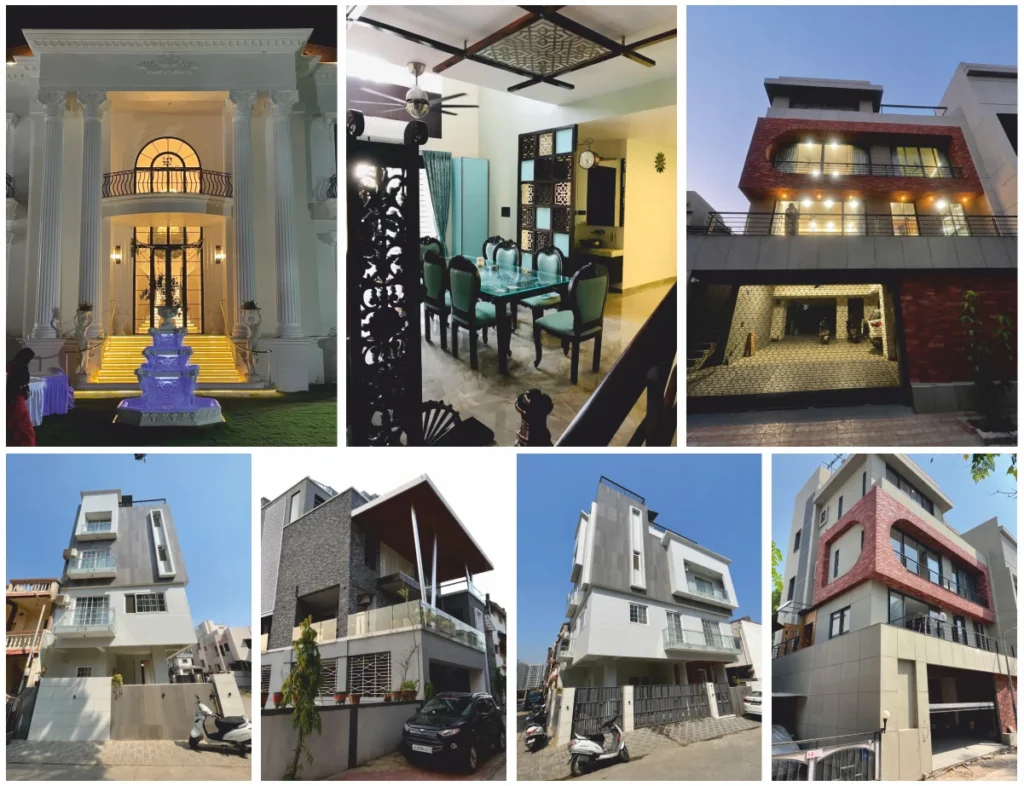
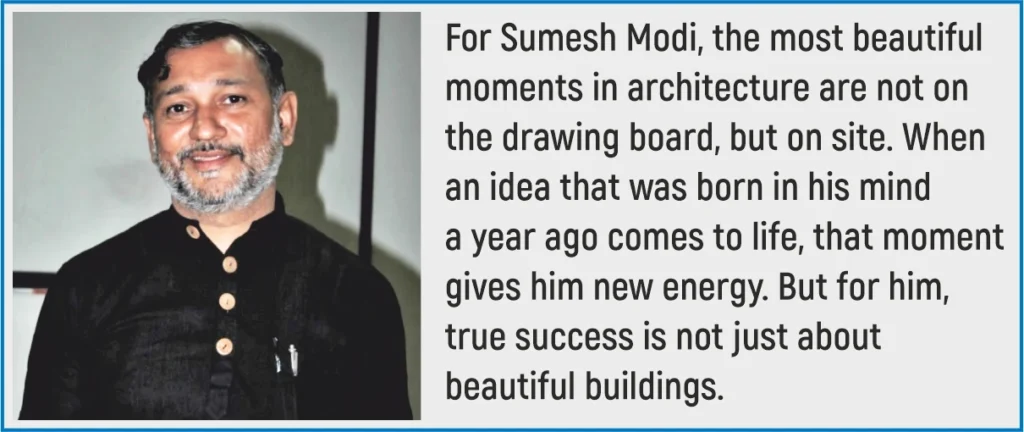
For Sumesh Modi, the most beautiful moments in architecture are not on the drawing board, but on site. When an idea that was born in his mind a year ago comes to life, that moment gives him new energy. But for him, true success is not just about beautiful buildings.
______________________________________________________
Disclaimer : This information has been collected through secondary research and Yugen Realty Newspaper is not responsible for any errors in the same.
Read more news including local, national, international, business on Yugen Realty Newspaper. Join us on social media to stay updated with the latest news.
FACEBOOK | INSTAGRAM | LINKEDIN | TWITTER | PINTEREST | YOUTUBE | WhatsApp Channel | Telegram