



Estimated reading time: 5 minutes
YUGEN REALTY, SURAT

Introduction
Modern construction is no longer just about erecting walls and roofs. The safety, durability and percentage of buildings largely depend on the quality of the materials used. Every bag of cement, every grain of sand, every drop of water and every steel rod — play a vital role in the strength of a construction. Physical verification and design compliance are common practice, but chemical testing has now become an indispensable part of construction quality control.
Although invisible on site, chemical testing acts as a “Silent Guardian” — ensuring that materials comply with Indian Standards (IS Codes) and international quality standards. As construction becomes more complex and technology-driven, the importance of this testing is increasing.
What is Chemical Testing?
Chemical testing is the scientific analysis of materials used in construction — to check their chemical composition, impurities and usability. While physical tests measure compressive strength or hardness, chemical tests detect hidden defects that may compromise the strength of the structure.
Chemical testing is performed on the following materials :
- Cement (OPC, PPC, slag cement)
- Fine and coarse aggregates
- Water
- Steel reinforcement
- Admixtures and new generation materials
Its purpose is to ensure compliance with IS codes and prevent hazards like corrosion, alkali-silica reaction, cracking or premature degradation.
Materials Subjected To Chemical Testing
1. Cement
Cement is the backbone of concrete. Common chemical tests include :
- Loss on Ignition (LoI) : Measures incomplete combustion.
- Insoluble Residue : Checks purity.
- Lime Saturation Factor (LSF) : Ensures proper mixing.
- Alumina/Iron ratio : Affects setting time and strength.
- Magnesium Oxide (MgO) : Prevents excessive swelling.
- IS Code : IS 4032:1985, IS 269:2015
2. Aggregates (Sand and Rock)
Aggregates constitute 60–75% of the volume of concrete. Impurities cause cracking and weakening.
Tests Include :
- Chloride and sulphate content (to prevent steel corrosion)
- Organic impurities (to prevent delayed setting)
- Alkali reactivity (to prevent ASR)
- IS Code : IS 2386 (Part 2 & 7), IS 383:2016
- 3. Water
- Water quality is extremely important. Tests include :
- pH value (between 6–8.5)
- Total dissolved solids (TDS)
- Chloride and sulphate content
- Hardness and alkalinity
- IS Code : IS 3025 series
4. Steel Reinforcement
The quality of steel is important for the strength of concrete.
Chemical Tests Include :
- Carbon, sulphur, phosphorus content
- Manganese content
- Ductile reducing impurities
- IS Code : IS 228, IS 1608
5. Admixtures and New-age Materials
Tests for admixtures like plasticizers, superplasticizers, retarders etc. :
- Chloride content
- pH
- Specific gravity
- Compatibility with cement
Furthermore, chemical testing of green materials like fly ash, GGBS, slag, recycled aggregates is required for safety and percentage.
Major Chemical Tests
| Sr. No. | Material | Test Parameter | Purpose | IS Code |
| 1 | Cement | LOI, Insoluble Residue, LSF | Purity & Strength | IS 4032 |
| 2 | Aggregates | Chlorides, Sulphate, Alkali, Organic | Durability & Corrosion | IS 2386, IS 383 |
| 3 | Water | pH, TDS, Hardness, Chloride, Sulphate | Concrete bonding & strength | IS 3025 |
| 4 | Steel | Carbon, Sulphur, Phosphorus, Manganese | Ductility & corrosion | IS 228, IS 1608 |
| 5 | Admixtures | Chloride, pH, Specific gravity | Compatibility & durability | IS 9103 |
Laboratory and Field Testing
Field tests (such as slump tests, visual inspections, rapid kits) give immediate results, but lab tests are more accurate.
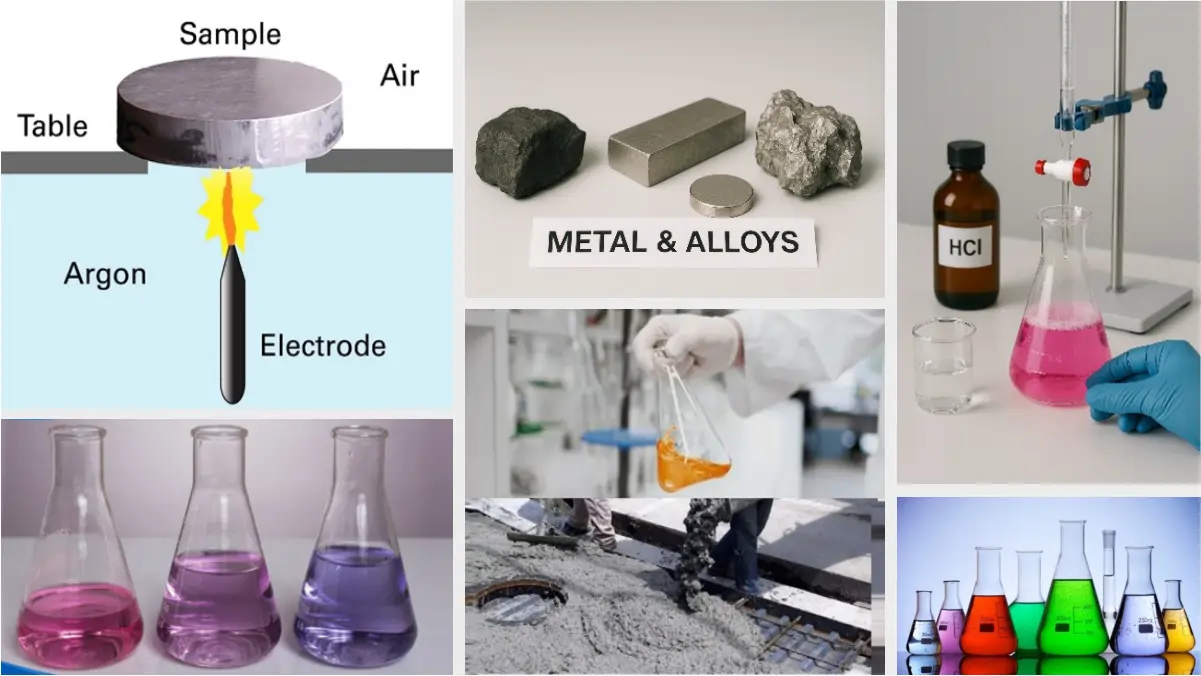
Modern labs use :
- Spectrophotometer
- Optical Emission Spectrometer (OES)
- Turbidity meter
- pH meter
- Titration Setup
Sampling is extremely important — engineers periodically take random samples and send them to NABL-accredited third-party labs.
Importance and Benefits of Chemical Testing
- Prevents Corrosion : Protects steel if chloride/sulfate is present.
- Ensures Compatibility : Admixtures do not react negatively with cement or water.
- Prevents Swelling and Cracking : Reduces Alkali-Silica Reaction.
- Maintains pH Balance : Proper pH is essential for concrete bonding.
- Long-term benefits : Reduces maintenance costs and extends the life of the structure.
Example : A bridge project in Gujarat avoided possible corrosion by chemically testing aggregates and water before pouring concrete — and saved crores of rupees in repairs.
Role in Sustainable and Green Construction
Chemical testing is essential for fly ash, GGBS and recycled aggregates to :
- Not harm the environment
- Available as strong as natural materials
- Comply with LEED and GRIHA standards
- Thus, chemical testing contributes to sustainable development.
Implementation Challenges
- Lack of awareness : Small contractors avoid testing due to cost.
- Cost constraints : Investment is required for full lab testing.
- Training needs : Site engineers need training to understand the testing.
- Lack of technology integration : Smart labs and digital record systems are not yet widespread.
Future Directions
- Smart Labs : IoT-based monitoring and automated testing.
- AI Analytics : Predicting material behavior and risk.
- Real-time data sharing : Faster decision-making.
- BIM Integration : Linking quality data with construction information.
Chemical testing will become more advanced and reliable with technology.
Conclusion
Chemical testing is the silent guardian of construction quality. Although invisible on site, it ensures the strength, durability and safety of every structure. In this era of India’s development, investment in chemical testing is mandatory — not an option.
______________________________________________________
Disclaimer : This information has been collected through secondary research and Yugen Realty Newspaper is not responsible for any errors in the same.
Read more news including local, national, international, business on Yugen Realty Newspaper. Join us on social media to stay updated with the latest news.
FACEBOOK | INSTAGRAM | LINKEDIN | TWITTER | PINTEREST | YOUTUBE | WhatsApp Channel | Telegram