



Estimated reading time : 5 minutes
YUGEN REALTY, SURAT
The Gujarat government’s decision to place the draft Annual Statement of Rates (ASR), commonly known as Jantri, in the public domain for 2024 has sent ripples across the real estate sector.
The proposed Jantri hike, ranging from 50% to a staggering 1,000%, is poised to have far-reaching consequences for developers, homebuyers, and landowners alike.
This is particularly alarming given that the rates were already doubled in April 2023, making this the steepest Jantri increase in recent memory.
Impact on Real Estate Development
The sharp increase in Jantri rates is likely to make new projects financially unviable. Floor Space Index (FSI) and Transferable Development Rights (TDR) costs, calculated based on Jantri rates, will rise significantly.
For instance, in areas like Sarthana, the proposed Jantri rates exceed actual market land values. Developers are already warning of frozen land deals and stalled projects until clarity on the new rates emerges.

As Sanjay Mangukiya, CREDAI Surat Chairman, notes, “This hike will lead to higher stamp duty and project costs, making development unfeasible and likely bringing the sector to a standstill. The increased costs will ultimately be passed on to homebuyers, further dampening housing demand.”

Speaking to Yugen Realty Newspaper Jasmat Vidiya, Chairman, CREDAI Gujarat said, “While aligning Jantri rates with market prices may aim to bring transparency, the proposed steep hikes threaten to disrupt real estate transactions across Gujarat. Such increases will not only make housing unaffordable for many but also burden builders with unsustainable costs, potentially paralyzing the sector. A balanced and phased approach is imperative to safeguard the real estate ecosystem and ensure equitable growth.”
Escalating Housing Costs
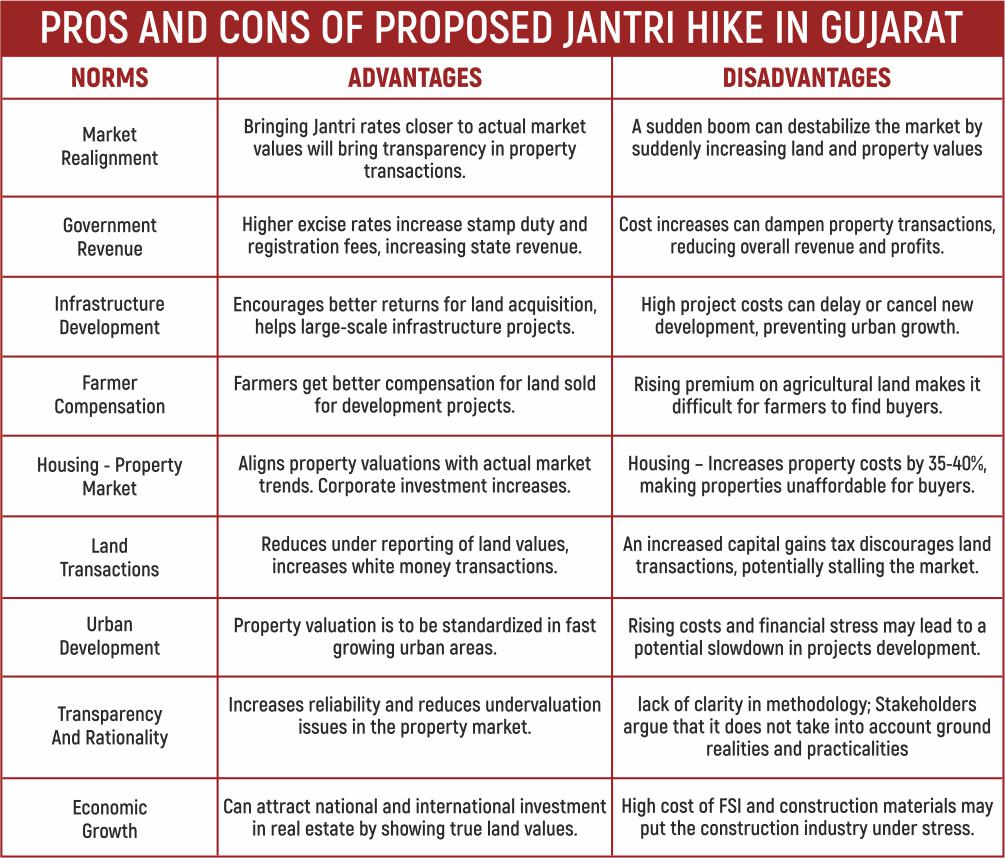
The hike is expected to inflate housing prices by 35-40%. The higher costs of land acquisition and FSI will push up the prices of residential and commercial units.
For instance, in Vesu, where Jantri rates have increased from ₹ 64,000 to ₹ 1,05,000 per square meter, a 3 BHK flat priced at ₹1 crore could see an additional ₹ 12 lakh in stamp duty and registration fees.
This price escalation will strain middle-class families and first-time homebuyers, potentially excluding them from the market. With housing demand already sluggish, this additional burden could lead to a prolonged market slowdown.
Challenges for Farmers and Landowners
Farmers, who own significant tracts of land in developing areas, will face difficulty finding buyers. The increased premiums for converting agricultural land into non-agricultural use will erode their profits.
In many areas the Jantri rate for agricultural land has risen from ₹ 1,500 to ₹ 12,000 per square meter, leading to an eight fold increase in premiums.
Implications for Redevelopment Projects
Redevelopment and slum rehabilitation projects will also suffer. Builders rely on TDR policies, which are directly linked to Jantri rates.
With TDR costs likely to skyrocket, many redevelopment projects will become financially unsustainable. This will particularly impact urban centers where land availability is scarce, exacerbating housing shortages.
Capital Gains Tax and Land Transactions
The new rates are likely to discourage land transactions due to a sharp rise in capital gains tax. For example, a Jantri rate increase from ₹ 10,000 to ₹ 1,00,000 per square meter means the capital gains tax will rise tenfold.
Builders and landowners are already voicing concerns about a complete halt in land deals, further stalling real estate activity.
Broader Economic Implications
The proposed hike will also have ripple effects across related sectors. Construction costs are expected to rise by 30%, impacting industries like cement, steel, and labour.
The rental market will also feel the pinch, with property taxes tied to Jantri rates expected to double. Multinational companies leasing large office spaces may reconsider their presence in Gujarat due to these increased costs.

Government’s Rationale and Industry Response
The government justifies the Jantri hike as a necessary adjustment to reflect market realities, achieved through “Rationalization and Scientific Methods.”
However, the abrupt and steep increases have drawn criticism from developers and farmers’ associations, who argue that the methodology lacks transparency and fails to account for ground realities.
Representations from stakeholders are being collected until December 20, 2024, and district-level committees will review objections before finalizing the rates. Industry leaders, including CREDAI, are actively seeking dialogue with the government to mitigate these adverse effects.
While the Gujarat government aims to align Jantri rates with actual market values, the proposed hike threatens to destabilize the real estate sector.
Developers face higher project costs, homebuyers are burdened with increased prices, and landowners struggle with reduced demand.
If implemented without significant revisions, the draft Jantri rates could lead to a contraction in real estate activity, hampering one of Gujarat’s key growth drivers.
Stakeholders hope the government will consider their objections and adopt a balanced approach to avoid long-term repercussions.
______________________________________________________
Disclaimer : This information has been collected through secondary research and Yugen Realty Newspaper is not responsible for any errors in the same.
Read more news including local, national, international, business on Yugen Realty Newspaper. Join us on social media to stay updated with the latest news.
FACEBOOK | LINKEDIN | TWITTER | PINTEREST | YOUTUBE